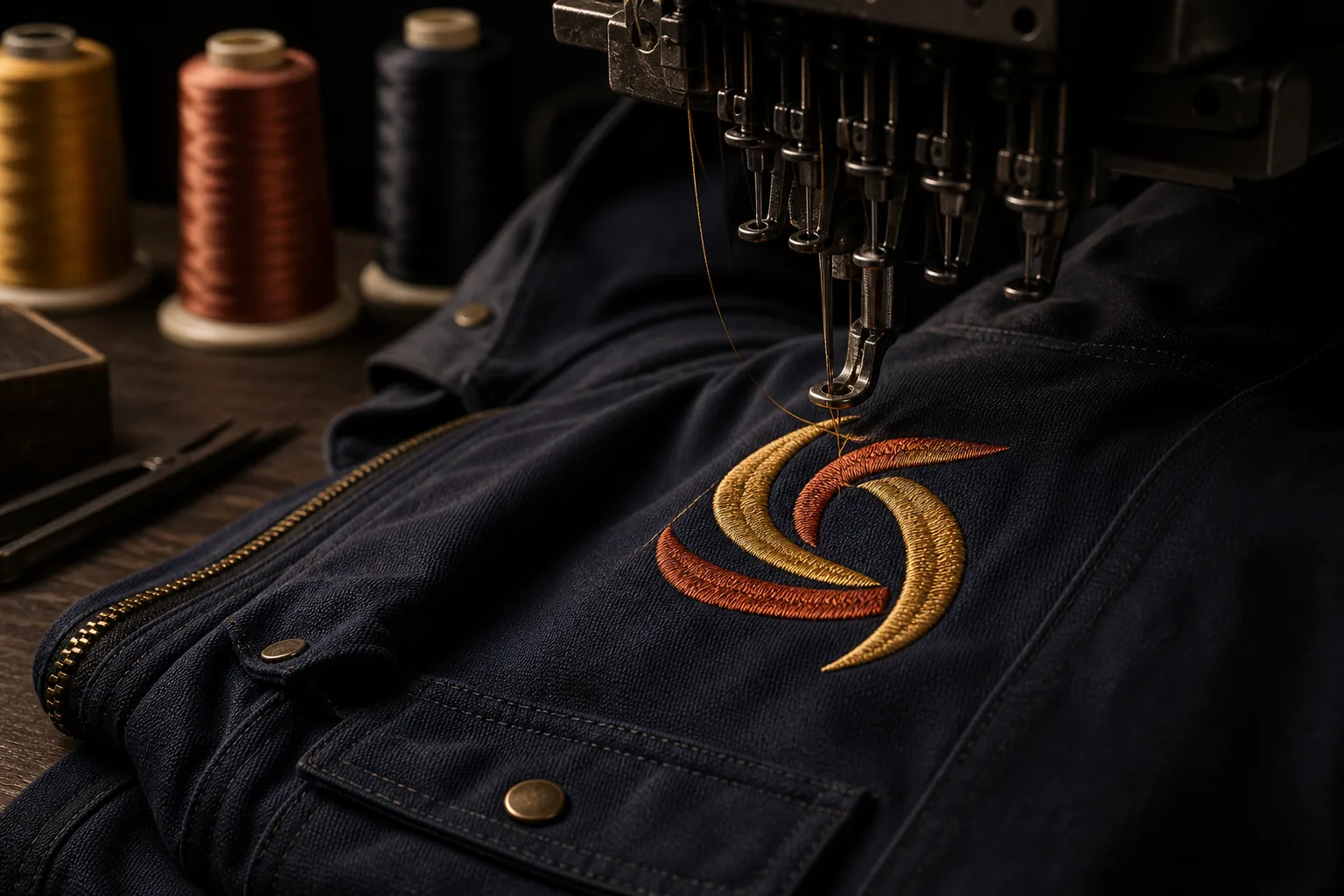
Embroidery digitizing turns artwork into instructions for a stitching machine. Before approving an order, confirm the finished logo size, garment, placement and thread colors, then ask how the provider checks the stitched result. A screen mockup can show layout; a sew-out helps you assess how the design behaves in thread.
What does embroidery digitizing actually change?
A logo image describes what you want to see. A stitch file describes how a machine should make it. Digitizing assigns stitch types, direction, density and supporting stitches. It also determines how the design is sequenced. Changing a file extension from PNG to DST does not do that work.
Printful’s digitization explanation describes this distinction and notes that files may differ between hats and apparel. Confirm the required file format with your own provider; DST is common, but the provider’s equipment and workflow determine what it accepts.
Prepare a brief for the actual garment
Send the original logo file if you have it, a clear reference image and the garment style. Specify the intended width or height in inches. ‘Left chest’ is a location, not a finished size. If a slogan is part of the logo, ask whether it remains readable at the requested dimensions.
For example, an illustrative order could use the same company wordmark on a polo and a structured cap. Treat these as separate applications until the provider confirms the digitizing can be reused. The curved cap surface and the polo fabric create different production conditions. Ask whether either application needs artwork simplification or a separate file.
Our artwork preparation guide helps you gather source files. For stitched garments, include the intended product and dimensions with those files rather than assuming print-ready artwork is also stitch-ready.
A digital proof and a sew-out answer different questions
A digital proof helps you check the spelling, overall composition, placement and specified size. A sew-out is a stitched sample. Ask whether the provider offers a sample on the intended fabric, a fabric swatch, a photograph, or another form of approval. These options are not equivalent, so record which one you are approving.
The Sharprint embroidery guide describes digitizing and sew-outs as steps in embroidery preparation. Its advice supports asking about a stitched proof; it does not establish what any matched provider includes free of charge.
Use this embroidery proof checklist
- Text: check the name, slogan, punctuation and letter shapes at the finished size.
- Dimensions: record the approved width and height, including whether they describe the whole logo.
- Placement: confirm the position relative to the pocket, placket, seam or cap panel.
- Thread: ask for the thread brand and color references the provider will use.
- Fabric behavior: inspect the sample for visible puckering, gaps or distortion and ask about any concern.
- Design changes: approve any removed detail, simplified shading or altered lettering explicitly.
View a physical sample under ordinary lighting when one is available. If you are reviewing a photo, ask for both a close view and a view showing the garment location. A close crop can make lettering look larger than it will appear when worn.
Who owns the digitized file, and can you reuse it?
Ask before paying the digitizing charge. Confirm whether the fee includes a copy of a machine file, a working file, future revisions or reuse only within that provider’s system. File ownership and release policies are commercial terms; do not assume that paying a setup charge grants every file format.
Keep the approved artwork version, file reference, dimensions, product and thread references in an order record. If you switch from polos to hats or change the logo size, ask the provider to review the file again. Our apparel reorder guide gives you a record template for that conversation.
What if the small text will not stitch clearly?
Ask for an actual recommendation at the intended size. Possible choices include enlarging the logo, removing a secondary line, using a simpler lettering treatment or selecting another decoration method. Each option changes the result, so approve it deliberately. Do not accept a digital enlargement as proof that tiny wording will remain readable on the garment.
If your design depends on gradients or photographic detail, review embroidery versus screen printing before committing. The best choice depends on the image and the garment, as well as your preferred finish.
Make approval a written production checkpoint
Reference the proof version and approved details in a short message: ‘Approved for [garment], [dimensions], [placement], using [thread references]. Please confirm the production and delivery dates.’ If you still have an unresolved concern, ask for a revision instead of issuing a conditional approval that can be misunderstood.
Explore Indianapolis embroidery matching or request a provider for your logo and garment. Indy Custom Apparel makes the connection; your provider confirms digitizing, samples, pricing and production.